|
If you have noticed fewer webinar invitations in your inbox recently, it wasn’t an absence. It was an intentional retreat to the writing desk to build what comes next.
For years, Global IOC focused on developing exceptional coaches. Through Core, Advanced, Master, and Chartered programs, we built deep fluency in inquiry, presence, and craft. That foundation remains vital.
Yet watching leaders return from immersive programs into entrenched organizational systems revealed a harder truth: knowing how to coach is not enough when the surrounding system continually invites you back into old patterns.
Individual capability matters enormously but sustaining it requires more. It requires internal agency, developmental infrastructure, and tools that help leaders work with what is happening beneath the surface rather than simply trying to change visible behavior.
What follows is the developmental architecture we are bringing forward to meet that challenge.
1. The Turnkey LeaderCoach System™: Building Internal Developmental Infrastructure
Organizations do not need another leadership program that evaporates the moment external facilitators pack up. They need the capability to cultivate leaders from within and sustain that growth in the flow of work.
We have re-architected the LeaderCoach System™ into a complete, turnkey framework designed to give organizations the capability to bring leadership development inside:
- Complete Developmental Toolkits: Participant learning modules and workbooks, workplace field application, mentor coaching guides, and the resources needed to carry the learning into practice.
- Applied Learning Environments: LeaderCoach Labs™ where capability can be observed in practice and Integration Cafés where leaders return to examine what happened when they applied the work inside their organizations.
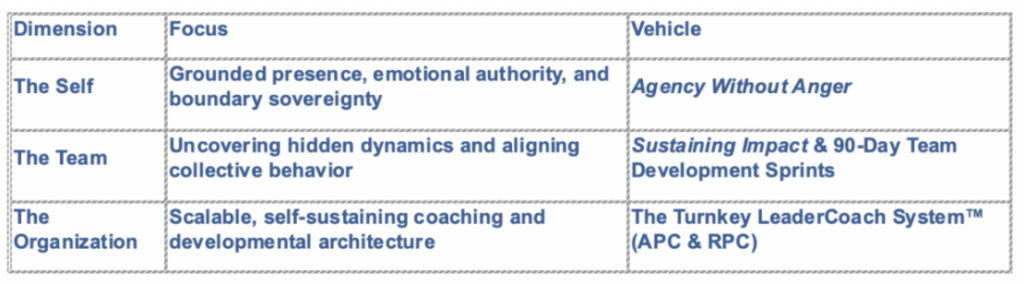
- From Fluency to Systems Thinking: The pathway progresses from foundational coaching fluency through the Affiliate Professional Coach (APC) level into the deeper capacity of the Registered Professional Coach (RPC), where leaders examine their own thinking, navigate resistance, recognize patterns, and work with the complexity of leading inside systems.
- Internal Sustainability: By preparing internal facilitators and mentors to carry the work forward, organizations develop the capability to sustain leadership development from within rather than remaining dependent upon an outside provider.
- Scale at a Fraction of the Cost: Once the internal facilitators and mentors are prepared and the developmental architecture is in place, organizations can develop successive cohorts of LeaderCoaches internally rather than purchasing externally facilitated development for each new group of leaders. The investment shifts from repeatedly buying programs to building an internal capability that can reach significantly more leaders at a fraction of the cost.
That last point matters because RPC is not simply about becoming better at coaching someone else. To become the kind of thinking partner this work requires, leaders have to become capable of examining and changing their own thinking as well. The LeaderCoach System™ is designed not simply to teach coaching skills, but to develop leaders who can continue thinking differently when the system around them is exerting pressure to return to what is familiar.
2. Sustaining Impact: Mapping the Terrain from Insight to Alignment
Coming at the End of September
Why can intelligent, capable people know precisely what they want to change and still find themselves returning to familiar patterns? The barrier is rarely a lack of insight or intention. More often, something in the terrain beneath the behavior continues to pull us toward what we already know.
Arriving at the end of September, the revised edition of Sustaining Impact: Mapping the Terrain from Insight to Alignment and the updated Sustaining Impact™ Assessment provide a way of working with that terrain through Awareness, Activation, and Alignment.
This work is also becoming the foundation of our Team Development Sprints, focused 90-day engagements that move beyond generic definitions of a “high-performing team” and begin instead with the team that is actually in the room.
Using individual and collective assessment data, we map the team’s current terrain and identify the patterns shaping communication, decision-making, relationships, accountability, and follow-through. The team can then work with what is actually happening rather than trying to conform to a model of what someone else has decided a high-performing team is supposed to look like.
3. Agency Without Anger: Uncompromising Presence
Arriving in October
Then there is the book that has occupied a very large part of my summer.
Agency Without Anger: Uncompromising Presence grew from a question that became increasingly difficult for me to ignore: What happens to our own agency when another person, a team, or even an organizational system recruits us into a pattern that is not ours?
We find ourselves defending, appeasing, over-explaining, fixing, withdrawing, accommodating, or fighting back, sometimes before we even recognize that we have stepped into someone else’s pattern.
Agency Without Anger explores the personal capacity required to recognize that recruitment, before automatically responding to it, remain the author of our own meaning-making in the presence of someone else’s emotional pattern, and exercise responsible authority and clear voice without rigidity, blame, or the need to overpower.
The deeper I went into this work, the more clearly I could see its connection to everything else we have been building. A leader who cannot recognize when they are being recruited into someone else’s pattern will struggle to remain a genuine thinking partner when the stakes rise, just as a team whose members continually recruit one another into familiar responses will struggle to create sustainable change simply because everyone understands what they are supposed to do differently.
The Integrated Horizon
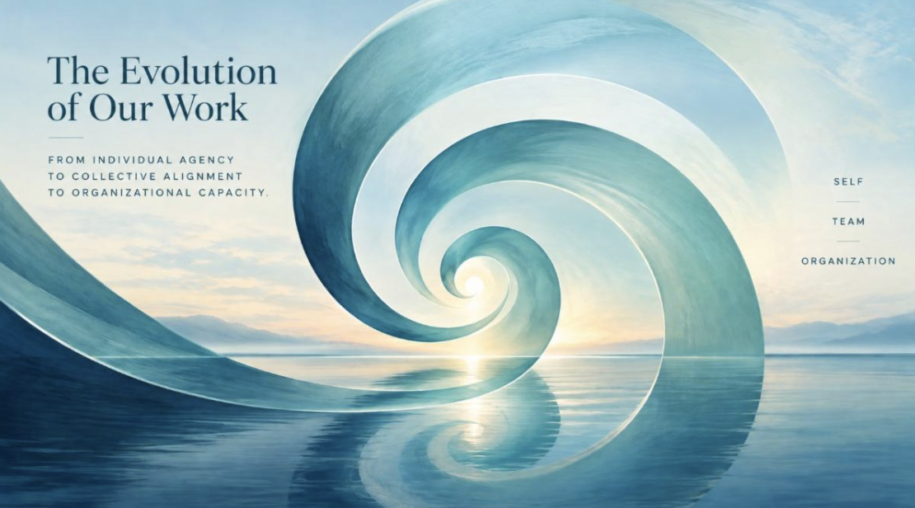
These initiatives are not isolated projects. They are part of a developmental architecture that connects what happens within us to how we lead, how we work together, and ultimately how organizations build the capacity to sustain development over time.
|
 Written by Peggy Marshall